
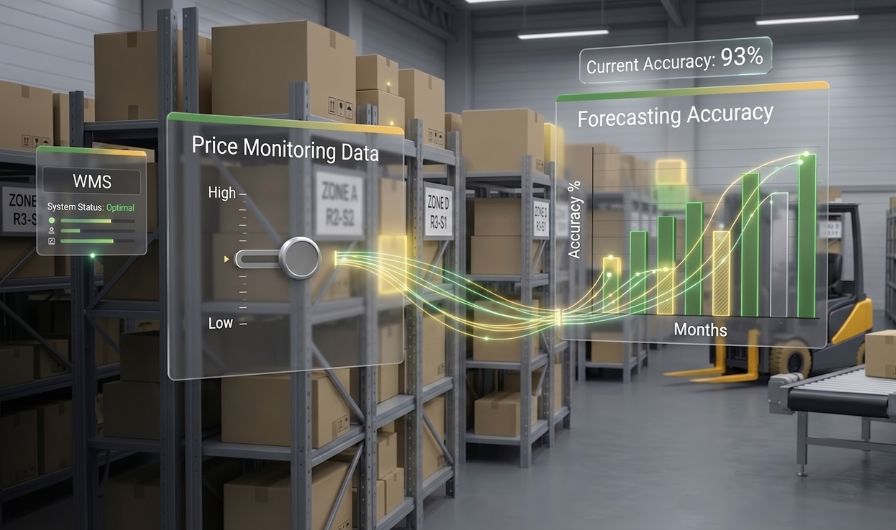
For years, the traditional demand forecasting model in retail relied on a retrospective approach: it was assumed that sales data for the same period last year (adjusted for trend and seasonality) provided a sufficient foundation for ordering. However, in modern retail, demand forecasting based exclusively on internal historical sales statistics is increasingly failing. The consumer is not confined within the walls of a single store: they instantly compare offers, react to promotions, and switch to competitors where conditions are more favorable.
Specifically, research by Retail Dive shows that 54% of shoppers use their smartphones in-store to check or compare prices. As a result, price ceases to be a local characteristic of the shelf — the consumer can instantly compare offers from various retailers.
The core thesis of modern logistics is that price is not just a commercial department tool, but a critical factor for inventory management. Without taking the market context into account, any forecast remains “sterile” and detached from reality, leading to the accumulation of excess stock (overstock) or product shortages (out-of-stock).
1. Why Demand Forecasting Based on Historical Data Becomes Dangerous for the Retailer
In an environment of hyper-competition and complete price transparency, traditional planning models become risky. The main issue lies in the so-called “statistical blindness” effect: when a forecasting algorithm analyzes only your internal data (ERP/BI systems), it sees the dry figures of the result but fails to see the reasons behind their change.
Suppose last week your sales of a specific SKU dropped by 40%. The internal system interprets this as a decline in interest in the product and automatically reduces the next order. However, the real reason for the drop is an aggressive “buy one get one free” (1+1) promotion at a competitor across the street. As soon as the neighbor’s promotion ends, shoppers will return to you, but the system has already ordered too little stock, and it will be insufficient. The result is an out-of-stock situation and lost revenue due to an erroneous algorithm decision.
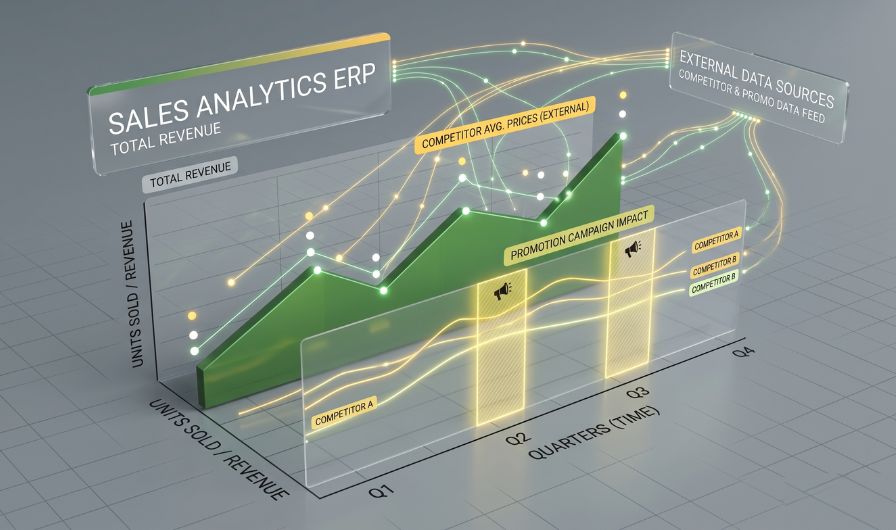
Factors That Internal Statistics “Do Not See”
A retrospective approach to pricing in retail ignores external factors that directly shape demand:
- Competitor promotional activity: price drops on KVI (Key Value Item) products in a neighboring chain instantly drain your traffic.
- Market assortment changes: the emergence of a new player or the launch of an exclusive brand by a competitor redistributes market shares.
- Regional price wars: in markets with a high concentration of retail, local price elasticity of demand can significantly differ from the chain average, as shoppers have more alternatives and compare prices more easily.
- External anomalies: unpredictable factors, such as sudden weather shifts (critical for beverage or ice cream categories) or local market logistics disruptions.
Financial Consequences of Ignoring Market Context
The lack of a connection between external competitor price monitoring and the replenishment system leads to two critical errors:
- Overstocks: you plan the procurement volume based on historical sales data but fail to account for a competitor’s dumping. Inventory accumulates, expiration dates lapse, and working capital is “frozen” in non-moving stock.
- Deficit (out-of-stock): you failed to notice that a competitor raised prices or faced supply chain disruptions. The flow of shoppers redirected to you, but due to a conservative order, your shelves emptied quickly.
Without integrating market data into the supply chain, a retailer is doomed to be constantly chasing demand instead of managing it.
2. Price as the Primary Demand “Trigger”: From Digit to Algorithm
In retail, demand is often perceived as a spontaneous phenomenon that can only be recorded. However, practice proves that demand is a manageable variable, where price acts as one of the primary levers. For this mechanism to work accurately, analyzing only your own price lists is insufficient; the overall market context must be considered.
The Concept of Cross-Elasticity
The traditional calculation of elasticity (sales response to changes in one’s own price) no longer provides the full picture today. Therefore, experts are implementing an expanded model that considers three dimensions of impact:
- Own price: the forecasted volume lift when the price is reduced.
- Competitor prices: the sales volume being “washed out” of your chain due to aggressive market offers.
- Internal interdependencies (cannibalization and halo effect): understanding how a promotion on one milk brand can negate the sales of another brand within your own shelf.
Today, price is not just a static label on a product, but one of the most important factors in retail demand forecasting models. To make this tool work to the business’s advantage, specialists apply the following technological solutions:
- Intelligent data cleansing: before building any forecast, the system automatically cleanses the sales history from the impact of past price anomalies and promotional spikes. This allows isolating the “baseline demand” — a real indicator of how much product the market needs without additional incentives.
- “What-if” scenario modeling: equipped with knowledge of market prices, a category manager can model a situation: “What will happen to my inventory if I keep my price unchanged while the market drops by 5%?”. This approach transforms demand forecasting from a guessing game into the calculation of specific financial risks.
Price Monitoring in the Fresh Category: How to Avoid Write-offs
In categories with a short shelf life, such as Fresh and Ultra-Fresh, price directly determines whether a product will be sold on time or written off. Let us consider a real-world situation: a chain purchases 500 kg of chilled chicken fillet at a regular price, expecting stable demand. Concurrently, a competitor launches a “Shock-price” promotion on an identical item.
Without timely competitor price monitoring and an automatic link to the replenishment system, the retailer learns about the problem too late: only when the product’s expiration date is nearing its end, while a portion of the batch still remains in the warehouse due to a lack of demand.
However, modern pricing optimization solutions allow avoiding such a scenario. The system automatically receives updated market data, identifies the critical price gap, immediately signals the need for a price review, and transmits the updated prices to the forecasting system to balance the order.
3. Integrating Monitoring Data into the Replenishment System: From PDF Reports to Algorithm
Competitor price monitoring is often perceived as a passive analytical tool. However, this is insufficient for effective inventory management. Competitor price data must automatically feed into sales forecasting algorithms.
This is precisely the approach applied by Consulting for Retail (C4R), an international consulting company specializing in the digital transformation of retail. In the professional solutions implemented by C4R specialists (such as SymphonyAI and Quicklizard), monitoring data ceases to be mere reports. It becomes a dynamic external factor for artificial intelligence algorithms, allowing the system to instantly adjust demand in line with market changes.
The integration process operates as a closed loop. Monitoring services collect data on competitors’ prices and stock availability. The system “sees” the change in competitor prices and, through price elasticity calculations, automatically computes the impact on the demand forecast for the future period. The updated forecast instantly enters the replenishment module.
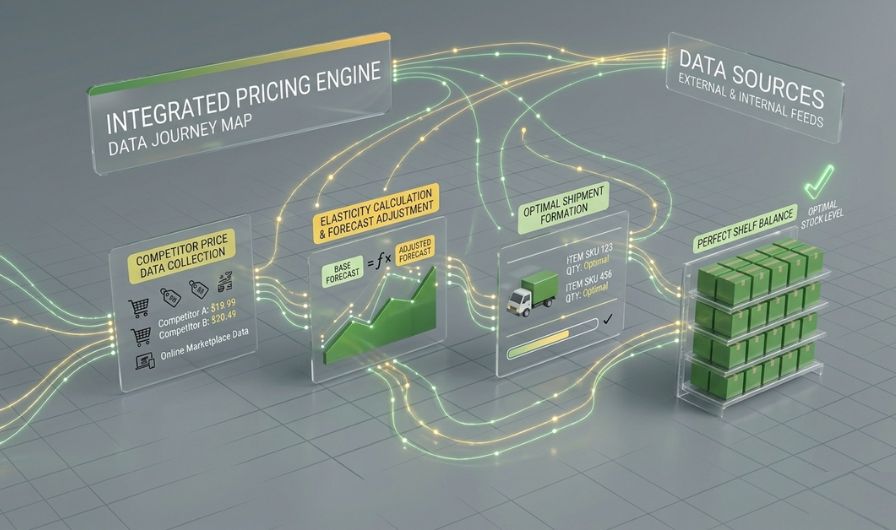
Depending on market signals, the algorithm operates according to one of the following scenarios:
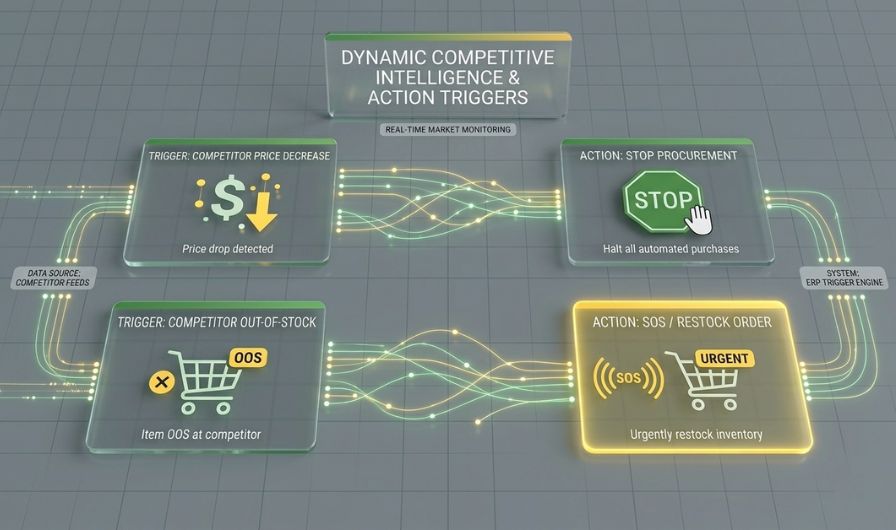
- When monitoring detects that a key competitor has dropped the price of an identical product below yours, the system reduces the sales intensity coefficient for this item and automatically recalculates the order volume to the supplier to prevent overstock. As a result, you do not receive stock at the warehouse that is bound to “sit” due to an uncompetitive price. Capital remains free for higher-velocity items.
- Conversely, if a competitor raised the price or triggered an out-of-stock status, the algorithm identifies a potential demand shift to your chain. The forecast is automatically adjusted upward. The system generates an additional order or a transfer from the warehouse to cover the demand spike. You avoid empty shelves, capture margin, and secure the loyalty of the customer who found the product at your store rather than the competitor’s.
Integrating market data into the replenishment system elevates inventory management to a higher level: the manager no longer spends time on mechanical work with stock balances but manages the parameters of the system that performs these calculations automatically.
4. Market Signals and Automated Reactions Matrix
For monitoring data to generate profit, algorithmic scenarios must be configured in the Supply Chain Management system. The expertise of Consulting for Retail allows automating the supply chain’s reaction to the following typical market situations:
| Market Signal | Monitoring Data | Potential Impact on Demand | Actions in Forecasting | Actions in Replenishment |
|---|---|---|---|---|
| Competitor decreases base price | Regular price change | Demand shifts to the competitor | Reduction of sales forecast | Order reduction |
| Competitor increases price | Regular price increase | Potential demand growth for our product | Forecast increase | Order increase |
| Competitor launches promotion | Promo price | Temporary drop in our demand | Forecast correction for the promo period | Replenishment reduction |
| Frequent competitor promotions | Promo frequency | Formation of a new reference price | Baseline forecast review | Average inventory volume review |
| Competitor out of stock | Availability status | Demand shifts to us | Forecast increase | Order increase |
| Launch of a new alternative product | New SKU | Demand cannibalization | Forecast review by SKU | Order correction |
| Product removed from assortment | SKU removed | Demand redistribution | Forecast growth | Order increase |
| Bundle offers | Bundle offer | Demand shifts to bundles | Demand review by SKU | Order correction |
| Multi-buy offers | Volume promotion | Average check growth | Forecast increase | Inventory increase |
| Special loyalty program prices | Loyalty price | Demand redistribution between channels | Forecast correction | Replenishment review |
| General price trend in the category | Price trend | Long-term demand change | Baseline forecast review | Inventory strategy adaptation |
C4R solutions allow not just collecting this data, but making it a part of daily business mathematics. The implemented tools transform external market noise into clear digital instructions for the replenishment system.
5. Five Strategic Benefits of Unifying Market Monitoring and Smart Replenishment
Synchronizing market data with SCM processes is not merely a technical improvement, but a transition to a Demand-Driven Supply Chain model. Consulting for Retail experts highlight 5 key effects that directly impact a retailer’s P&L (Profit and Loss) statement.
1. Working Capital Optimization: Fewer Non-Moving Items and Overstocks
When the demand forecasting system accounts for competitor price pressure, it blocks the procurement of excess inventory. You do not invest funds in stock that will sit motionless in the warehouse because the shopper chose a cheaper option on the market. This is particularly vital for categories with a high value per unit (e.g., alcohol, household chemicals) and goods with a limited shelf life. As a result, you achieve capital liberation for other strategic objectives.
2. Eliminating Shortages and Maximizing Revenue
The reverse side of the coin is the system’s capacity to instantly react to favorable market opportunities. If a competitor experiences a supply chain disruption or unjustifiably raises prices, your forecast grows automatically. The system ensures product availability exactly when an abnormally high demand for it arises. You avoid the “empty shelves” situation, resulting in increased service levels and customer loyalty. According to industry studies, stockouts can lead to a loss of about 4% of retailers’ annual revenue, as shoppers either switch to competitors or abandon the purchase entirely.
3. Reducing Operational Expenses via Automation
In a classical model, a category manager is forced to manually review a large volume of monitoring reports and apply edits to orders. This breeds error risks and a delayed response. Modern algorithms process thousands of SKUs in real-time. The system independently makes decisions to adjust orders based on predefined business rules. Consequently, staff productivity increases: managers focus on strategic category development rather than mechanical adjustment of spreadsheets and orders.
4. Improving Financial Planning and Budget Accuracy
The finance department frequently encounters discrepancies between planned and actual procurement budgets due to unpredictable market fluctuations. By integrating external factors into the forecast, procurement plans become highly accurate. The system accounts not only for your strategy but also for the expected market pressure. The result is budget transparency and predictability, enabling more precise management of supplier relations and bank limits.
5. Strategic Agility and Speed to Market
The retail market changes faster than a standard procurement cycle can conclude. The ability to alter the inventory strategy for the entire chain within 24 hours in response to competitor actions constitutes true agility. The result of this approach is enhanced business resilience against crises and price wars.
These five benefits define the potential for process optimization, but the key element is the transition to practical action.
6. How to Transition from Observation to Automated Management
Today, most large retailers have already established the process of collecting data on competitor prices. However, the pivotal question is what happens to this data after it is received. If it remains solely within category managers’ reports, it is passive observation that fails to influence the operational efficiency of the supply chain.
This data delivers true value only when it becomes an embedded part of an automated supply chain. Then, the retailer attains a fundamentally different quality of management:
- Predictivity instead of reactivity: you do not wait for a drop in sales; instead, you adjust the order the exact moment the market price changes.
- Mathematical precision: the impact of price on demand is evaluated objectively through elasticity algorithms and ML (Machine Learning) models, rather than subjectively.
- Resource liberation: the procurement team rids itself of routine tasks and focuses on vendor management and category strategy.
- Measurable result: implementing this approach allows reducing non-moving inventory levels by an average of up to 20% within the very first months of operation.
Automating the link between market prices and procurement converts ordinary analytics into an actionable inventory management mechanism. Utilizing intelligent forecasting and replenishment systems allows the retailer not merely to catch up with the market, but to operate proactively, maintaining an ideal balance of goods on shelves under any conditions.