

Psychological pricing is a strategy that sets prices based on how customers perceive them—rather than strictly on production costs or market data. The main goal is to make a price feel attractive on an emotional level, creating a sense of value, affordability, or exclusivity.
Picture this: it’s evening, you’re relaxing, and you decide to browse a few online stores. No particular goal—just looking around.
Suddenly, you spot that item. You don’t exactly need it, but there are only a couple left in stock. And it’s on sale. The discount is so good that walking away feels impossible.
There’s no time to think it over. No “maybe later,” no saving it to a wish list. You just grab it and check out.
Statistics show that up to 80% of shoppers make impulse purchases at least once a month.
Around 60% admit that discounts or limited stock are the decisive factors.
And when “only a few left” combines with “on sale,” the brain interprets it as a rare opportunity you simply can’t miss.
The marketing formula is simple and effective: scarcity + urgency = “I’ll buy it before it’s gone.” Even the most rational buyers can quickly turn into the main character of the story: “I wasn’t planning to… but I bought it.”
In this article, we’ll explore seven psychological pricing techniques that actually work in online retail. And, of course, we’ll explain how to apply these techniques wisely to increase conversion while maintaining customer trust.
What Is Psychological Pricing in E-Commerce?
In e-commerce, price is more than just a reflection of production costs or a desired markup. It’s a psychological signal that directly influences a shopper’s decision-making process. Customers often decide within seconds whether to buy or walk away—and how the price looks can make all the difference.
Simply put, the goal of psychological pricing is to influence purchasing decisions through emotion rather than pure logic.
For example, a price of $9.99 feels significantly cheaper than $10, even though the difference is only one cent. This is known as charm pricing or rounding down.
In retail, companies like Walmart and Amazon often use unconventional price formats to guide consumer choice. Price tags ending in “7”—such as $9.97 or $19.97—are proven to catch the eye and boost sales.
So, why do some prices feel like a bargain while others seem unreasonably high? The answer lies in how our brains process numbers, emotions, and perceived value—often without us even realizing it.
Principles of Price Perception
1. We don’t just see a price — we feel it
People perceive prices emotionally: expensive, cheap, a bargain, something feels off. The emotional reaction matters as much as (or more than) the number itself.
2. We compare, even if we don’t want to
Prices never exist in a vacuum. The moment we see one, our brain instinctively looks for a reference point:
-
the price of a similar product at another store;
-
a price we remember from before;
-
our internal expectation of “what it should cost”;
-
even the price of something completely unrelated.
This is called reference price perception.
For example, if you once bought a shampoo for $5, seeing it later for $7 will likely feel “too expensive,” even if that’s a fair market price.
3. We trust prices that feel logical
A price should “match” the product’s look, packaging, and the store’s presentation.
-
A budget brand selling for $987 raises suspicion.
-
A premium brand priced at $2.99 can feel equally off.
There has to be a balance between the perceived value and the product’s appearance.
4. We feel the pain of spending money
Every purchase is a small psychological stress: we give money and get something in return. A good price helps soften that “pain”:
-
turning a one-time payment into “$3/month”;
-
$399 feels gentler than $400;
-
phrases like “gift with purchase,” “on sale,” or “discounted” make the transaction more pleasant.
5. We like to feel in control
When shoppers believe they’ve found a great deal on their own, it’s satisfying.
Smart pricing isn’t just about numbers — it’s about giving customers the feeling of winning.
Even if the discount was planned by marketers, the buyer feels they discovered it themselves — creating a sense of satisfaction.
6. We don’t like doing math — the store should do it for us
The simpler the price, the higher the chance of purchase.
Prices like $799 instead of $1,000, or “2 for the price of 1,” are instantly processed as deals because the brain saves effort.
7. A discount works only if it’s believable
A huge markdown (e.g., from $1,000 to $99) sparks doubt.
People sense inauthenticity and lose trust.
But “20% off for our store anniversary” feels reasonable and credible.
8. Urgency and scarcity boost perceived value
Phrases like “only 3 left” or “offer ends today” shift the focus from the price to the fear of missing out. This reduces price sensitivity and increases conversions.
Book a Consultation with Our Specialist
7 Strategies That Influence Shopper Behavior
The process of influencing a customer starts long before they click “Buy.” Businesses that understand the psychology of choice gain a competitive edge: they don’t just sell a product—they create value, stand out from competitors, and hold the customer’s attention. From smart pricing and transparency to subtle marketing triggers, every detail can shape the buying decision.
Here are 7 proven techniques that help attract attention, prompt action, and boost sales—without relying solely on deep discounts or price wars. These can be integrated into your strategy today so that every price, every description, and every offer works in your favor.
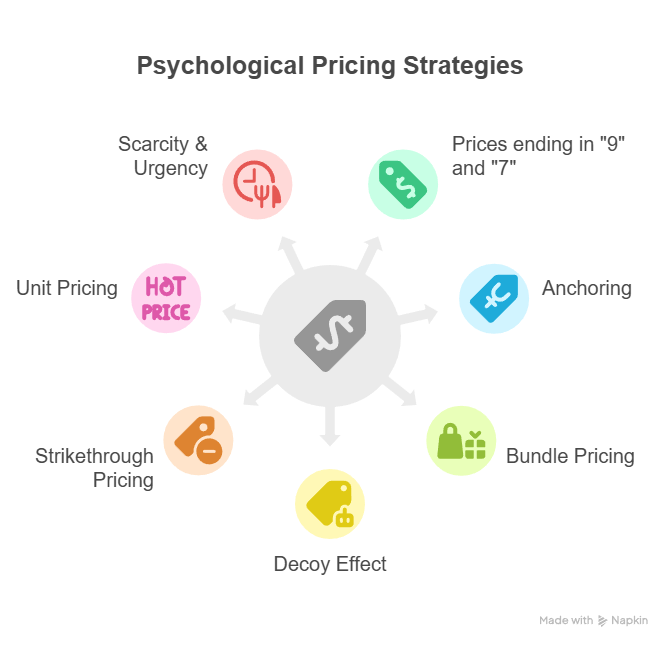
1. Prices Ending in “9” and “7”: The First-Impulse Effect
It may sound cliché, but this effect has worked consistently for decades. A price of $199 doesn’t feel like “almost $200”—it feels closer to $100. Our brain focuses on the first digit (in this case, 1), creating a sense of a better deal.
Why it works
People feel prices rather than calculating them rationally. Psychologically, $199 seems closer to $100 than to $200—especially when scrolling quickly with little time for analysis.
The difference between “7” and “9”:
Prices ending in “7” often feel more deliberate and less like a marketing gimmick. For example, $197 may seem like a “calculated market price,” while $199 screams “sales tactic.” Many brands use “7” to signal precision.
Business impact:
-
Can lift conversion rates by 5–7%, which is huge in e-commerce.
-
Useful for A/B testing to find the optimal perception point.
Where it works best:
-
Online product listings with side-by-side comparisons
-
Budget and mid-range products
-
Sales and promotions where every dollar matters
2. Anchoring: Making One Price the Reference Point
The anchor price is the first number a shopper sees—it sets the context for all other prices. Even subconsciously, the brain uses it as a benchmark.
How it works
Show a $5000 item first, then a very similar one for $3200. The second will feel like a bargain—even if the value gap is small.
Anchors can be set by
-
Showing a premium option before the standard one.
-
Demonstrating features/benefits first, then revealing the price.
-
Using strikethrough pricing: “Was $1200, now $799”.
Where it’s effective
-
Product pages with multiple variants
-
Discounts and sales
-
Pricing tables on landing pages (high → mid → low options)
3. Bundle Pricing: Increasing Cart Value with Sets
Bundle pricing offers multiple products together for one total price. Even if the savings are minimal, customers perceive it as a better deal.
Why it works
People tend to overvalue the perceived benefit of getting “more” in one package.
Business benefits
-
Higher average order value
-
Moves slow stock by pairing it with popular items
-
Boosts conversion rates by framing the purchase as a smart deal
▶ Examples:
-
Three identical products in one pack (common in FMCG)
-
Product + accessory combo (e.g., gadget + case + charger)
-
“Buy 2, get the 3rd free”
4. The Decoy Effect: Steering Customers Toward a Target Choice
Add a third option that’s intentionally less attractive but close in price to your premium offering.
▶ Example:
-
Plan A: $20/month, basic
-
Plan B: $40/month, premium
-
Plan C (decoy): $39/month, fewer features than premium
Customers are nudged toward the premium plan because the decoy makes it look like the smarter choice.
5. Strikethrough Pricing: A Visible Discount
Showing the original price crossed out next to the new one instantly communicates savings. Adding “-20%” or “Offer ends today” boosts urgency.
Why it works
-
The old price acts as an anchor
-
The new price looks like a win in comparison
Boost the effect with
-
Time limits (“Today only”)
-
Scarcity indicators (“Only 3 left”)
-
Exact discount percentages
6. Unit Pricing: Honest Comparisons
Showing the cost per unit (per item, per 100g, per liter) makes price comparisons clear and builds trust.
Why it works
-
Reduces the mental effort of calculating value
-
Positions the brand as transparent and customer-focused
Where to use it
-
Groceries (per 100g, per liter)
-
Cosmetics and household goods (per ml, per oz)
-
Subscription services (per class, per week)
7. Urgency & Scarcity: Speeding Up Decisions
Limited quantities and deadlines push customers to act quickly.
▶ Examples:
-
“Only 3 left at this price”
-
Countdown timers on sales
-
Labels like “Bestseller” or “Running Out Fast”
Why it works
It shifts focus from price to the fear of missing out (FOMO), reducing hesitation and increasing conversions.
Case Studies: How Psychological Pricing Works in Practice
These cases show how the psychological pricing techniques described earlier can directly impact key performance metrics.
Data comes from Price Control’s internal analytics, validated by client results, and cross-referenced with well-known research in this field.
| Pricing Technique | Scenario Example | Result Achieved |
|---|---|---|
| Prices Ending in “9” | Product listed at $199 instead of $200 | +6% conversion rate |
| Anchoring | Showing premium product first, then the basic one | +14% sales of basic option |
| Bundle Offer | 3 items sold together for one set price | +12% average order value |
| Decoy Effect | Plans: Basic / Standard / Premium | 63% chose “Standard” |
| Strikethrough Pricing | “–20%” discount with old price displayed | +18% CTR in product listings |
| Scarcity & Urgency | “Only 3 left” message on product page | +9% conversion on product page |
These cases are based on actual results from Price Control clients, combined with insights from industry studies and e-commerce best practices.
How to Implement Psychological Pricing
Psychological pricing isn’t just about changing $500 to $499. It’s a structured approach where pricing becomes a strategic tool to influence how customers perceive and respond to your offer.
Here’s a step-by-step guide to implementing psychological pricing in your business:
1. Define Your Goal
What do you want your pricing to achieve?
-
Increase conversions?
-
Raise average order value?
-
Clear out old inventory?
-
Stand out from competitors?
Each objective calls for a different pricing tactic.
2. Understand Your Customer
The right psychological trigger depends on your audience:
-
B2C: works best with “.99” endings, countdown timers, bundles
-
B2B: rational arguments, cost-per-unit transparency
-
Premium segment: value alignment over “cheap” appeal
3. Select the Right Techniques
Possible tactics to introduce:
| Technique | What It Does | Where to Use It |
|---|---|---|
| Prices Ending in 9 and 7 | Boosts conversions by making prices feel “cheaper” | Product pages, promotions, email campaigns |
| Anchor Price | Makes your target price look like a better deal by comparison | Pricing plans, landing pages |
| Decoy Effect | Steers customers toward the desired option | Three-tier pricing, subscriptions |
| Strikethrough Price | Strengthens the sense of getting a bargain | Discounts, banners, clearance sales |
| Unit Pricing | Helps customers compare and decide quickly | FMCG, multi-packs, groceries |
| Scarcity & Urgency | Speeds up purchases, reduces procrastination | All e-commerce categories |
| Bundles & Sets | Increases average order value | Marketplaces, both offline and online products |
4. Test Your Hypotheses
A/B testing is your best friend:
-
$499 vs. $505
-
“–20%” vs. “Save $10”
-
Three-tier pricing with a decoy vs. two simple options
Track clicks, add-to-cart actions, purchases, and abandonment rates.
5. Automate Price Displays
For e-commerce or SaaS, integrate tools such as:
-
Countdown timers
-
“Only N left” stock widgets
-
Strikethrough pricing plugins (Shopify, WooCommerce, OpenCart, etc.)
6. Justify the Value
Psychological pricing works better when backed by a reason:
-
Tie discounts to events (anniversary, seasonal sale)
-
Add benefit statements: “Best deal in category,” “Only $0.18 per unit”
7. Refresh and Adapt Techniques
Buyer psychology evolves. Update formats, rotate techniques, and adjust based on behavioral data.
When Psychological Pricing Doesn’t Work (and How to Avoid Mistakes)
Psychological pricing is a powerful tool — but when applied incorrectly, it can backfire. Not every tactic is universal, and understanding its limits is essential.
1. The “Aggressive Marketing” Effect
If you overuse psychological tricks — like always ending prices with .99 or running “permanent discounts” — customers stop perceiving them as real deals. They feel manipulated.
Solution: use these tactics sparingly. Test their impact through A/B experiments and customer surveys.
2. Segmentation Errors
What works for the mass market can repel a premium audience. Buyers of high-end products expect transparency and stability, not “penny games.”
Solution: tailor your pricing strategy by segment. Premium customers value prestige and service, not discounts.
3. Ignoring Competitive Context
Even the smartest psychological approach won’t help if your price is 30% higher than competitors’ without explanation. In e-commerce, customers can compare options in seconds.
Solution: combine psychological pricing with regular competitor monitoring. Use data to justify your price differences.
4. Fake Discounts Undermine Trust
When the “original price” looks inflated or never changes, customers lose trust. It feels like deception.
Solution: create honest, transparent promotions. A limited-time offer is better than an obviously fake “old price.”
5. Ignoring Cultural and Regional Differences
Price perception varies across countries and cultures. What inspires trust in the U.S. might look suspicious in Eastern Europe.
Solution: study local behavior — number perception, color psychology, discount formats, and currency display conventions.

How Price Control Helps Implement These Strategies
Price Control is more than a competitor monitoring tool—it enables you to execute and test pricing strategies that shape customer perception and drive sales.
-
A/B Testing of Price Hypotheses: Compare $199 vs. $200, regular vs. discount pricing, single-item vs. bundle deals—based on real sales data.
-
Live Competitor Monitoring: Detect competitor price drops (including hidden promotions) in real time, so you can react without sacrificing margin.
-
Automated Psychological Triggers: Set rules for decoy pricing, charm endings, time-limited offers, or freebies with purchase—triggered automatically under chosen conditions.
The result: a pricing system that informs you about the market and actively manages customer perception—without over-reliance on deep discounts.
Conclusion: Pricing as Influence, Not Manipulation
Psychological pricing is about understanding how customers think and feel—not tricking them. The better you tailor prices to audience behavior, the more likely they’ll convert.
Start small: test price formats, add urgency cues, highlight discounts. Measure, refine, and build a pricing system that consistently works for you.
🎁 Get Your Free Demo Today
7 days FREE + a personalized market report for your business.
📞 +38 098 990 22 39
📩 info@pricecontrol.com.ua

Would you like to learn more or receive a consultation? Contact us!

0 Comments